

One hand can't clap by itself
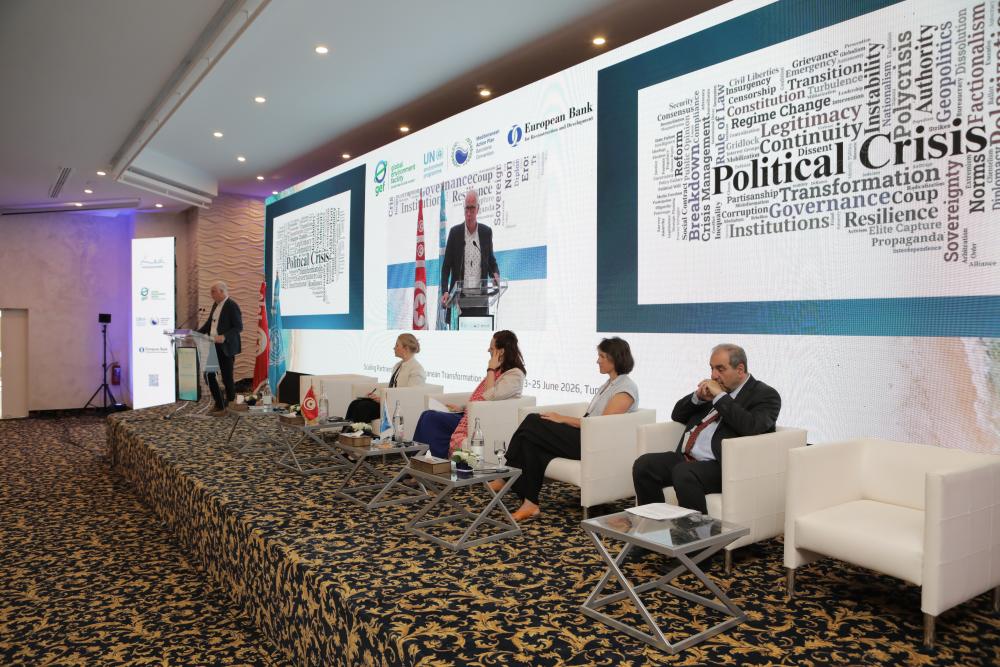
In Tunis, at the final Annual Stocktaking Meeting of the MedProgramme, no one needed to pretend the Mediterranean was simple.
It is not.
It is one sea, but it carries many pressures: pollution, water stress, biodiversity loss, climate risk, coastal development, hazardous waste, fragile ecosystems, complex institutions and countries moving at different speeds. It is also a sea of shared responsibility. No country can protect it alone. No institution can fix it alone. No project, however well designed, can carry the weight by itself.
That was the spirit of the Fourth Annual Stocktaking Meeting of the MedProgramme, held in Tunis from 23 to 25 June 2026 under the theme One Sea, One Vision: Scaling Partnerships for Mediterranean Transformation and Impact. The meeting marked the concluding milestone of the MedProgramme and opened a forward-looking discussion on what should happen next: how to keep results alive, how to turn knowledge into action, and how to move from successful demonstrations to wider Mediterranean change.
The tone was set early. Tunisia welcomed the meeting as “both a privilege and a valuable opportunity”. Tatjana Hema, UNEP/MAP Coordinator, recalled a Tunisian proverb: “One hand alone cannot clap.” It was more than a ceremonial line. It became the simplest explanation of what the MedProgramme tried to do.
It brought many hands together.
Over its lifetime, the MedProgramme connected ten countries, regional institutions, scientific organisations, financial partners and implementing bodies around one basic idea: Mediterranean environmental problems are linked, so solutions must also be linked. The Programme worked across Chemicals and Waste, International Waters, Biodiversity and Climate Change Adaptation, showing that pollution, water, ecosystems, climate resilience and livelihoods cannot be treated as separate files.
The ASM did not present this as a perfect story. That would not have been credible. The Programme had to work through delays, uneven timelines, procurement issues, data gaps, political instability, institutional complexity and the everyday difficulty of coordinating many actors across countries and sectors. But what emerged in Tunis was not a story of a programme that avoided problems. It was the story of a programme that learned how to work through them.
That may be its most important legacy.
On the first day, the focus was on vision, achievements and partnerships. The opening and strategic framing sessions placed MedProgramme results within a much larger global reality: a world facing environmental stress, political uncertainty and pressure on sustainability ambitions. Hans Bruyninckx framed the challenge clearly: the Mediterranean now needs to move “from project, to programme, to systemic change.” His presentation asked what Mediterranean responses are needed in a turbulent global context and pointed to sustainability not as a side issue, but as an organising principle.
That idea ran through the country stories.
Lebanon showed how coordination matters when institutions are under pressure. Its MedProgramme experience brought together work on Chemicals and Waste, International Waters, aquifers, Integrated Coastal Zone Management and the Damour Integrated Management Plan. The point was not only the list of activities. The point was that ministries, partners and technical teams had to exchange information, align processes and build a shared planning base.
Montenegro showed another kind of integration. Coastal planning in Boka Kotorska, the Buna/Bojana aquifer, PCB management, Roma community awareness, gender-sensitive health and safety planning, and FishEBM activities all spoke to one broader national objective: stronger coastal and marine governance. In the transcript, the Montenegro intervention captured this well: the value of the MedProgramme was “not only in the individual projects and the results, but also in the collective contribution of its components to broader national objectives.”
Morocco showed how evidence can become structure. The country presentation linked WEFE Nexus, ICZM, aquifers, Chemicals and Waste, climate resilience, new POPs activities, Rhiss-Nekkor aquifer work and ENVITECC. It also showed a country thinking beyond isolated activities towards prioritised national pathways.
Tunisia, as host country, stood at the centre of the story. Its portfolio connected Chemicals and Waste actions with EBRD and UNEP, MedPOL–MedWaves cooperation, submarine groundwater discharge work, WEFE Nexus demonstration, wastewater, aquifers and support to the national ICZM Strategy. Tunisia’s role was therefore not only ceremonial. It was also substantive: a national example of how MedProgramme themes can meet in one place.
Libya brought biodiversity, groundwater, offshore monitoring, Farwa Lagoon MPA and new POPs prevention into the same discussion. Its case mattered because it showed that even in difficult contexts, environmental cooperation can continue to create technical and institutional building blocks.
These were not polished success stories in the usual sense. They were working stories. They showed the quiet machinery of cooperation: meetings, data, laws, site assessments, inventories, monitoring stations, workshops, plans, platforms, technical reports, procurement routes, community outreach and institutional patience.
The second day shifted from what had been achieved to what could travel.
The MedProgramme Replication Portfolio was introduced with a strong sentence: “MedProgramme created results that can travel.” It is a simple line, but it captures the purpose of the final ASM. Results should not stay where they were first produced. A solution tested in one country should be understandable to another. A method developed by one partner should be visible to the next. A good plan should not die inside a report.
The Portfolio framed the transition from results to decision-ready pathways: identify scalable solutions, map where they can work, link them to policy entry points and partners, and move towards action on the ground. Its core message was “from experience, to integration, to systems-level scale.”
This is where the MedProgramme began to look less like a conventional project and more like a regional memory system. It had produced plans, inventories, standards, assessments, maps, dashboards, strategies, pilots and studies. The challenge was now to make them usable.
That was also the point of the Digital Transformation Showcase. One slide put it sharply: “Tool + Data + Context = Intelligence.” Another explained that the Knowledge Management data component aims to make data useful by connecting implementation progress, gender, geospatial information, external datasets, narrative and documentation.
This matters because data alone does not change decisions. A number without context is just a number. A map without explanation is just a map. A report without access is just a file. The Knowledge Management Platform 2.0 was presented as an integrated digital system connecting data, knowledge and decision-making. Its purpose is to capture, organise and preserve knowledge generated across Child Projects, support exchange of lessons and good practices, and strengthen the science-policy interface.
One of the most human ideas in the digital session was that a solution that worked in Tunisia could become discoverable for a team in Montenegro because context was attached to the data. That is what knowledge management should do. It should help people find each other’s experience before starting again from zero.
The third day turned towards finance and the future.
By then, the meeting had already shown that MedProgramme results were real. The harder question was what would happen to them after closure. The Sustainable Finance session was designed around this challenge: how to move “from demonstration projects to investment pipelines”, how to use the Replication Portfolio as a pipeline tool, and how to transform climate and coastal risks into investment opportunities.
This was one of the most important shifts in Tunis. The conversation moved from environmental results to investment readiness. The agenda was clear: countries need ownership, feasibility work, risk reduction, partners and finance. Technical readiness is not enough. A good idea needs a lead institution, a policy entry point, a costed package, safeguards, economic logic and a financing route.
The breakout groups followed the same discipline. They were asked to move beyond broad discussion and identify practical routes: the solution, interested countries, policy entry point, partners, financing option, first step and lead contact. This format reflected the ASM’s sailing metaphor. The wind may be the pressure or opportunity, but partners still need to adjust the sails together.
That is the real MedProgramme story.
It is not that everything was solved. It was not. The Mediterranean still faces the same pressures, and many results still need financing, ownership and continued institutional support. But the ASM showed that the Programme created something valuable: a way of working.
It showed that countries can use regional frameworks without losing national priorities. It showed that Regional Activity Centres and technical partners can act as long-term custodians of methods and standards. It showed that science can support policy when translated into practical tools. It showed that gender, youth and community participation are not decorations, but part of credible environmental action. It showed that finance must be invited earlier. It showed that knowledge has to be managed, not scattered.
Above all, it showed that partnership is not a slogan. It is work.
It is the work of aligning timelines that do not align. Translating technical language across institutions. Making data usable. Keeping countries engaged. Turning lessons into tools. Turning tools into decisions. Turning decisions into finance. Turning finance into action.
At the final ASM, the MedProgramme did not simply count what had been done. It looked at what could continue.
That is why Tatjana Hema’s message matters: the MedProgramme stands “not at the end of the story, but at the beginning of a broader Mediterranean transformation.” The Programme’s next life will not be measured only by final reports. It will be measured by whether countries use the tools, whether partners keep the knowledge alive, whether investment follows evidence, and whether Mediterranean cooperation continues to move from project to system.
One hand cannot clap on its own.
But in Tunis, many hands did.