


Building Regional Transformation on Proven Results
Replication is one of the defining features of the MedProgramme. Conceived as an integrated regional programme rather than a collection of isolated projects, it has worked across countries, sectors and institutions to address interconnected pressures on the Mediterranean from pollution, hazardous chemicals and water scarcity to climate risk, coastal degradation and biodiversity loss.
This breadth has given the Programme something particularly valuable: a wider understanding of what countries need, what has already been tested, where implementation capacity exists and what still prevents proven solutions from advancing. It has also revealed how individual achievements can become more powerful when connected when scientific evidence informs policy, governance mechanisms support investment, and successful interventions become models for wider application.
The MedProgramme’s Replication Portfolio capitalises on this experience. It identifies results with the potential to travel, tests them against country demand and policy priorities, and translates them into realistic opportunities for further action. Each opportunity brings together the MedProgramme evidence, the problem it can help address, national or regional ownership, the next practical step, the remaining readiness gap, potential delivery partners, financing options, expected benefits and the risks or dependencies that must be managed.
The ambition is not simply to preserve what the MedProgramme has achieved, but to ensure that its strongest results continue to generate impact within the Mediterranean regional governance system. The MedProgramme Replication and Upscaling Portfolio can serve as a transition platform, connecting demonstrated solutions and country priorities with the UNEP/MAP–Barcelona Convention framework, while linking them to future grant, concessional, blended and, where appropriate, private finance. In this way, the Portfolio provides a bridge from successful interventions to country-owned programmes, investment pipelines and lasting institutional change, while supporting the mainstreaming of MedProgramme approaches, knowledge and partnerships into regional policies, programmes and implementation mechanisms. It therefore strengthens both the financial and institutional sustainability of the MedProgramme legacy.
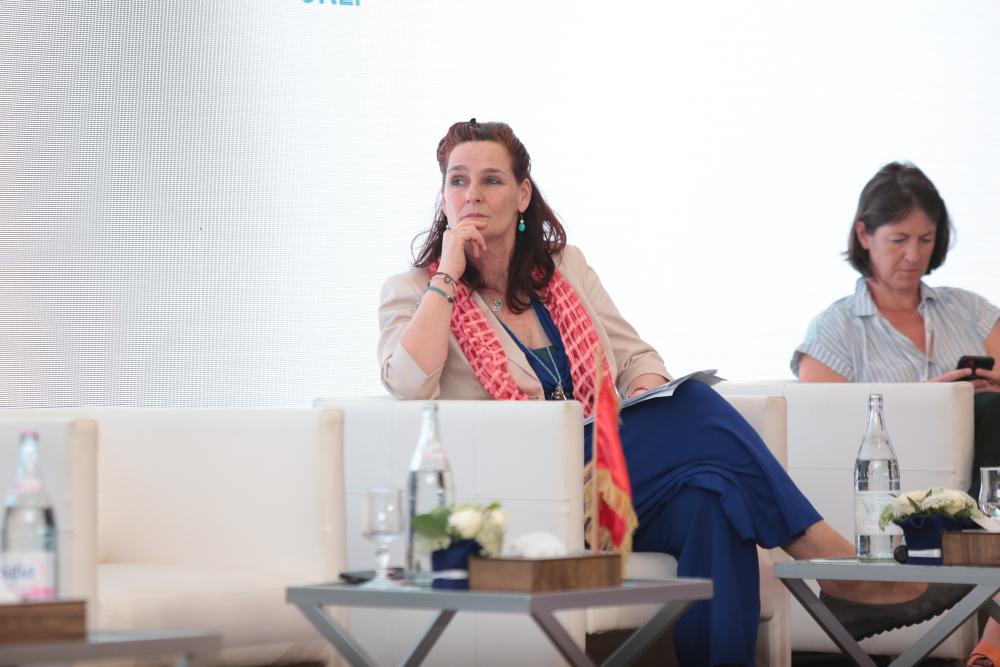
Christine Haffner-Sifakis of the MedProgramme Coordination Unit explains why replication is central to the Programme’s legacy and how integrated experience can help shape the next generation of Mediterranean action.
1. The MedProgramme has generated hundreds of activities, tools and demonstrated approaches. Which results have the greatest potential to deliver wider impact, and why?
The greatest potential lies not only in individual outputs, but in the MedProgramme’s ability to bring complementary results together and turn them into credible pathways from evidence to implementation, replication, investment and impact at scale.
That is one of the real strengths of the MedProgramme’s integrated design. By working across environmental priorities, countries, sectors and institutional levels, we have built a unique body of experience that tells us not only what works, but also where needs and solutions converge, what can realistically be scaled, and what barriers still need to be overcome—whether technical, institutional, policy-related or financial.
This matters enormously in the Mediterranean because the region’s environmental challenges do not exist in isolation. Pollution affects ecosystems, health and livelihoods. Water scarcity is closely linked to energy, food security and climate resilience. What happens along our coasts has direct implications for biodiversity, resilience and economic opportunity. So the real opportunity is to move beyond addressing these challenges and their solutions separately.
This is precisely what we are doing through the MedProgramme Replication and Upscaling Portfolio: looking across the Programme’s results and asking how they can be combined and taken further. PCB identification, for example, becomes much more powerful when it is linked to safeguarding and disposal, equipment replacement, regulatory strengthening and financing. Wastewater assessments can become the starting point for feasibility studies, project preparation and infrastructure investment. Climate-risk evidence can move from analysis into coastal planning, adaptation decisions and financing.
And importantly, these approaches have already been developed, demonstrated or tested in Mediterranean contexts. The opportunity now is to build on that experience, adapt it to national and regional priorities and bring together the enabling conditions, partnerships and financing needed to take successful approaches to scale.
That is ultimately what makes the replication approach so promising: it turns the MedProgramme’s accumulated results into a forward-looking portfolio of opportunities for the Mediterranean—connecting what has already been achieved with what countries and partners can do next.
2. Replication is sometimes understood as simply repeating a successful project elsewhere. What does meaningful replication actually require?
For me, meaningful replication is much more ambitious than copying a successful project. It is about understanding what worked, why it worked, and then asking the question: how can we take that success further—into another place, another sector, another institution, or ultimately to a larger scale?
A proven technical solution is an essential starting point, but it is only one part of the equation. Successful replication requires country demand and ownership, alignment with national priorities and regional commitments, and institutions that are ready to champion the next phase. We also need to understand the enabling environment: Do we have the necessary capacity? What partnerships are needed? What are the risks? And crucially, what financing pathway can move the opportunity forward?
This is where the MedProgramme Replication and Upscaling Portfolio becomes very pertinent. For each promising result, we need to identify the next concrete step. One opportunity may need a feasibility study or detailed costing; another may require regulatory approval, safeguards or stronger institutional arrangements. Others may be sufficiently mature to move into project preparation or towards implementation finance. The important point is that within the MedProgramme, we create a credible pathway from a demonstrated result to the next level of action.
And I think it is important to see replication as part of a wider continuum. Replication takes an effective approach into a new context. Upscaling expands its reach and impact. Mainstreaming embeds successful approaches into policies, standards, budgets and institutional practice. And sustainability, in the case of the Mediterranean through integration into the Barcelona Convention UNEP/MAP framework, ensures that those benefits continue well beyond the life of a project.
3. How is the Replication Portfolio helping countries move from proven results to clearly owned, prioritised and financeable interventions?
The Replication and Upscaling Portfolio is designed to bridge the gap between a successful result and the next policy, programme or investment decision.
It begins with evidence of what the MedProgramme has already delivered or generated. It then asks a set of questions. Does the opportunity respond to a recognised country or regional need? Is it aligned with an existing policy or institutional entry point? Who owns it? What precisely should happen next? What is still missing? Who could help deliver it? What type of finance is realistic? What benefits could it generate, and what risks or dependencies must be addressed?
This moves us beyond compiling a catalogue of achievements. Countries and financing partners need structured propositions that show why action is needed, what has already been proven, how ready the intervention is and what support could unlock it.
Through country Replication Atlases and a forward-looking portfolio, MedProgramme experience can be translated into prioritised opportunities at different stages of readiness. Some may require grant support for early preparation or institutional strengthening. Others may be suited to concessional or blended finance, while selected interventions may attract private-sector participation. The financing route must follow the nature and readiness of the intervention not the other way around.
4. What are the main barriers between interest and implementation, and what support is needed to overcome them?
The central lesson is that interest alone is not enough. As shown through our MedProgramme country outreach mission, countries already understand the problem and identified priority interventions, yet specific elements of support and assistance are needed to move forward.
The needs may be technical, such as an updated assessment, feasibility study, detailed design, safeguards or costing. It may be institutional, including the need for a clear mandate, effective coordination or targeted implementation capacity. It may concern policy alignment, regulatory uptake, procurement, or long-term monitoring. In some cases, the decisive barrier may simply be access to appropriate finance.
The immediate task is to validate the strongest opportunities with national counterparts, confirm the responsible lead, establish the relevant policy entry point, inter-sectoral coordination and agree on the first actionable step. Potential partners and financiers can then be engaged around a defined proposition for action.
5. What must happen next to ensure that the MedProgramme’s strongest results become national programmes, investment pipelines and lasting changes across the Mediterranean?
The first requirement is country-led prioritisation. Countries and partners have started to identify where proven experience, policy relevance, ownership, implementation capacity and potential impact come together most strongly.
Each selected opportunity then needs a practical route forward: a responsible national or regional lead, clearly defined partners, a realistic next step, an assessment of the outstanding readiness gap, indicative costs and an appropriate financing pathway. Expected environmental and socio-economic benefits must be clear, and important risks and dependencies must be identified before investment decisions are made.
The Replication Portfolio is to remain a living mechanism well transitioned and anchored in the regional governance framework of the UNEP/MAP system. Its value and sustainability will lie in supporting continued engagement among countries, UNEP/MAP, the GEF, development banks, technical organisations, national institutions and other financing partners. Progress can be measured by the number of potential new projects, but also by policy uptake, institutional adoption, investment mobilised and environmental improvements delivered.
This is where the MedProgramme’s integrated model has particular value. It has produced more than individual project results. It has created a regional body of evidence and practical experience showing how environmental pressures, institutions, policies, technical solutions and investment needs connect.
The MedProgramme has produced results that can travel. The next step is to ensure that they travel with country ownership, policy alignment through the Barcelona Convention and other regional frameworks, credible partners and the right finance and that they deliver lasting benefits for the Mediterranean environment and the people who depend on it.